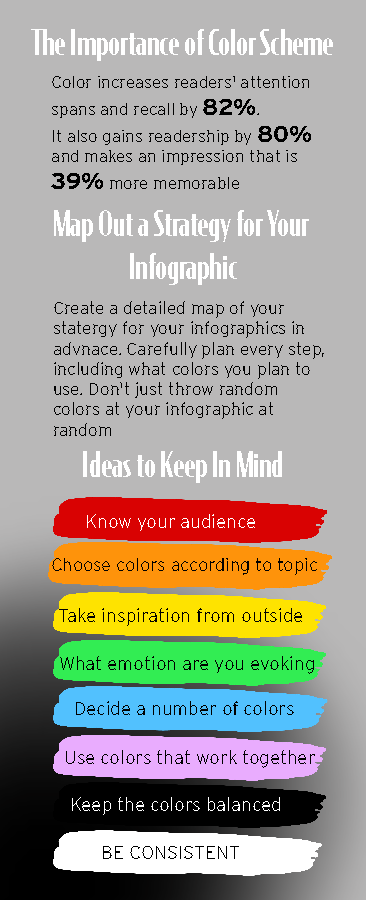
Color Scheme
A document's color scheme addresses its use of color, which can be a important way to establish consistency and meaningful contrast.
There are two fundamental color models in document design: CMYK—which stands for Cyan (blue), Magenta (red), Yellow, and Key (usually black)—is a subtractive color model used when designing for print; RGB—which stands for Red, Green, and Blue—is an additive color model used when designing for the screen.
Color schemes can be articulated with a color wheel:
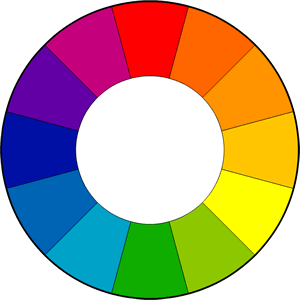
The wheel contains the three primary colors: blue, red, and yellow. If each is mixed with its neighbor the result is the secondary colors: green, orange, and purple. Repeating this process for the primary and secondary colors results in the intermediary tertiary colors. This completes the standard 12-color wheel, with which it is possible to identify different types of color relationships:
- Complementary: Colors directly across from each other, which are highly contrastive
- Triadic: Three colors equidistant from each other
- Split-Complementary: Three colors, one from the wheel and two on either side of its complement
- Tetradic: Four colors equidistant from each other
- Analogous: A small number of contiguous colors, which are highly consistent
- Monochromatic: The various shades and tints of a single hue
The warm half of the color wheel contains hues with red or yellow in them; the cool half contains hues with blue. Warm colors tend to be used for impactful accents; cool colors tend to recede into the background.
This reference chart Links to an external site. helpfully articulates different color scheme elements.